Submission 60
Role of Fluorodeoxyglucose Positron Emission Tomography/Computed Tomography in Addition to Standard Staging in Early-Stage Cervical Cancer: A Systematic Review Identifying an Evidence Gap
Presented by: Dana Stefanovic

1 Cancer Elimination Collaboration, The University of Sydney, Sydney, Australia
2 Fiona Stanley Hospital, Perth, Australia
3 Royal Perth Hospital, Perth, Australia
4 Envision Medical Imaging, Perth, Australia
5 Princess Alexandra Hospital, Brisbane, Australia
6 Sir Peter MacCallum Department of Oncology, University of Melbourne, Melbourne, Australia
7 Sir Charles Gairdner Hospital, Perth, Australia
8 Curtin University, Perth, Australia
9 Royal Brisbane and Women’s Hospital, Brisbane, Australia
10 University of Queensland, Brisbane, Australia
11 King Edward Memorial Hospital for Women, Perth, Australia
12 University of Western Australia, Perth, Australia
Introduction:
Accurate staging in early-stage cervical cancer is essential for guiding treatment decisions. MRI is the standard imaging modality for local staging, while FDG PET/CT provides complementary metabolic and anatomical information, particularly for nodal and distant staging. The incremental value of PET/CT relates to detection of additional disease and avoidance of multimodality therapy, balanced against potential false-positive findings and other clinical and resource considerations.
Methods:
This systematic review was part of the development of Australian clinical practice guidelines. A comprehensive literature search aimed to identify studies evaluating the additive value of PET/CT beyond standard initial staging (including MRI) in early-stage (FIGO 2018 IA2–IB2) cervical cancer before surgery. Where direct evidence was lacking, a structured synthesis of indirect evidence was undertaken for contextualisation and to support the guideline recommendations.
Results:
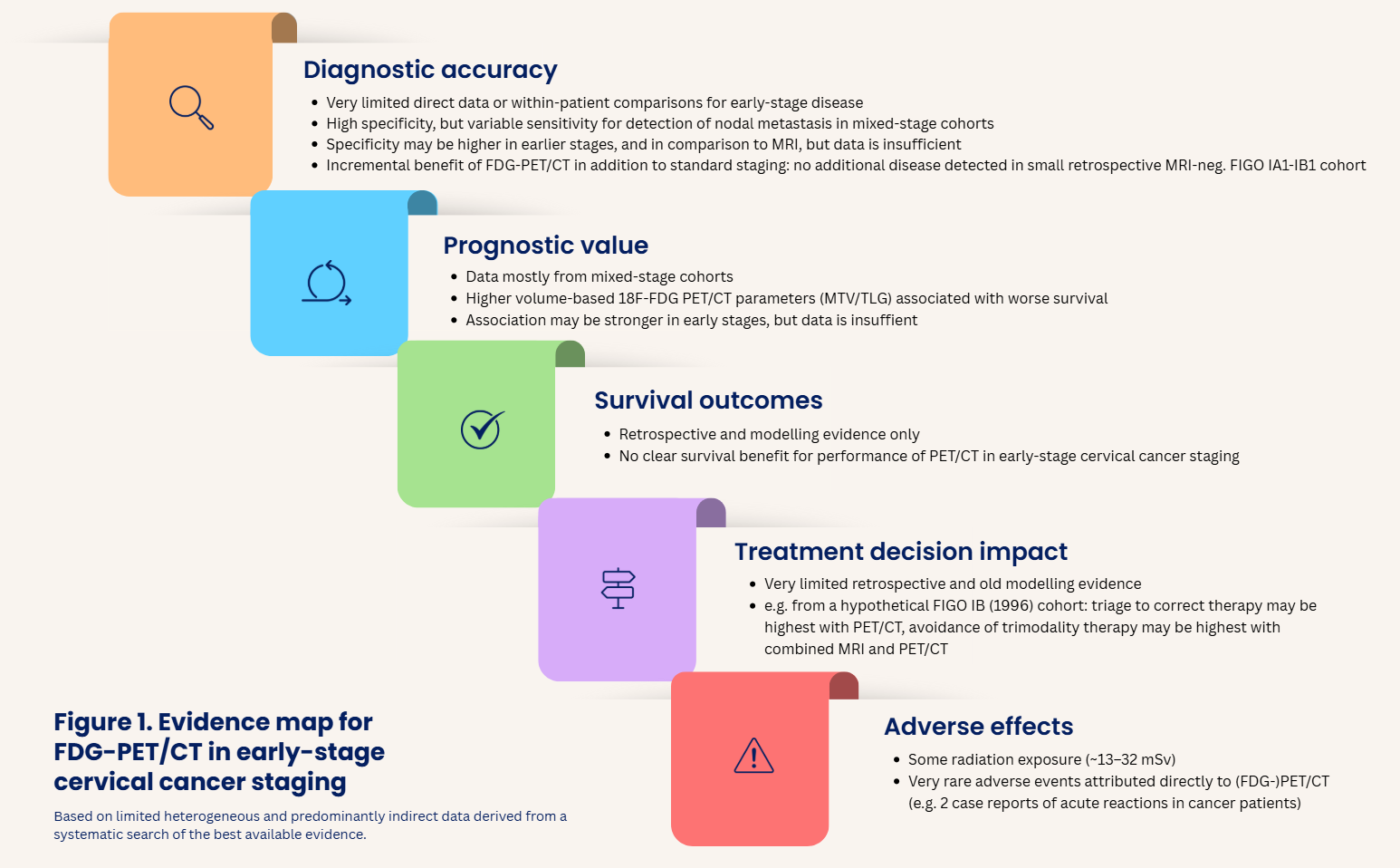
No studies met the predefined inclusion criteria and directly assessed the incremental benefit of PET/CT beyond standard staging in strictly defined early-stage disease. Broader literature review suggests that PET/CT may have high specificity and prognostic value in this setting. However, evidence is limited by small sample sizes, heterogeneous populations and sparse reporting of disease detected uniquely by PET/CT (see Figure 1).
Conclusion:
No direct evidence supports the incremental value of PET/CT beyond standard staging in FIGO IA2–IB2 cervical cancer, highlighting a relevant evidence gap. Current selection of early-stage patients for additional PET/CT imaging relies on extrapolation of limited indirect data and clinical reasoning. Evidence with well-defined populations is needed to define which patients benefit from addition of PET/CT.