
Introduction:
Despite Australia approaching cervical cancer elimination, some women will continue to be diagnosed with locally advanced disease (LACC). Concurrent chemoradiation with brachytherapy (CCRT+BT) remains the standard of care, yet 30–35% of patients experience disease progression. Immunotherapy has demonstrated benefit in metastatic disease and is now being evaluated for LACC. We conducted a systematic review (SR) and GRADE Evidence-to-Decision assessment to inform the first Australian Cervical Cancer Management Guidelines (ACCMG).
Methods:
A SR was undertaken following PRISMA 2020 guidelines comparing immunotherapy in combination with CCRT (I+CCRT) with CCRT in women with LACC (FIGO 2018 stage IB3, IIA2-IVA). We included randomised controlled trials or SRs thereof. Outcomes of interest included overall survival (OS), progression-free survival (PFS), grade 3-4 adverse events (AE) and quality of life (QoL). Searches using MEDLINE, EMBASE, and Cochrane databases identified one previous SR (Zhao 2024), which we updated. In consultation with the ACCMG Working Party (WP), 3+-year (preferably 5+-year) OS and QoL were identified as critical outcomes to inform the recommendation process.
Results:
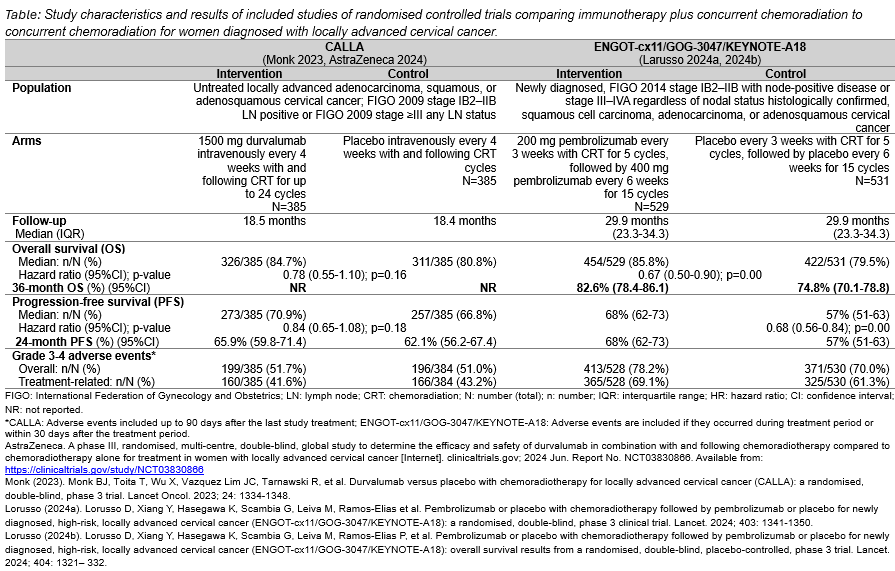
Two trials met inclusion criteria: CALLA (durvalumab) and ENGOT-cx11/GOG-3047/KEYNOTE-A18 (pembrolizumab) (Table). Only KEYNOTE-A18 reported both critical outcomes. Three-year OS was significantly higher in the pembrolizumab (82.6%) versus the control arm (74.8%) (hazard ratio 0.67, 95% confidence interval: 0.50–0.90, p=0.00). No significant difference in QoL between the two arms at 36 weeks was observed.
Conclusion:
The ACCMGWP conditionally recommended the addition of pembrolizumab to CCRT+BT for patients with 2018 FIGO III/IVA disease regardless of PD-L1 status, noting that shared decision-making should include discussion of immunotherapy-related AEs and patient preferences. Government subsidisation of pembrolizumab for LACC has since been announced ensuring equitable access. Recommendation and subsidisation decisions were based on improvement in 3-year OS (5-year OS data are pending). Further research exploring biomarker‑guided patient selection is warranted.