Introduction: Cervical cancer remains a leading cause of cancer morbidity and mortality among women. An estimated 662,301 new cases and 348,874 deaths occurred worldwide in 2022, making it the fourth most diagnosed cancer among women. In Kenya, it is the leading cause of cancer-related mortality among women, accounting for nine deaths daily.
Methods: A retrospective analysis of aggregate national data in the District Health Information Software 2 (DHIS2) platform was conducted covering five periods (April 2021–March 2022 through April 2025–March 2026). Data included screening using 1) visual inspection with acetic acid (VIA), 2) Human Papillomavirus (HPV) testing, 3) Pap smear, as well as treatment of precancerous lesions with 1) cryotherapy, 2) thermal ablation, and 3) loop electrosurgical excision procedure (LEEP), alongside screening uptake among HIV-positive clients.
Results: A cumulative 2,114,548 women were screened nationally. VIA accounted for the majority of screening volume (89%), while HPV testing and cytology contributed 5.6% and 5.3%, respectively. Annual screening volume increased from 112,278 in 2021-2022 to a peak of 556,357 (396% increase from baseline) in 2023-2024, followed by 505,368 in 2025-2026 (350% higher than baseline, but 9.2% lower than 23-24). Test positivity varied substantially by modality: 3.2% for VIA, 16.1% for HPV testing, and 6.3% for cytology; 18,008 clients (1%) presented with lesions suspicious for cervical cancer. Among 22,206 clients receiving treatment, thermoablation was the predominant modality (78.2%), followed by cryotherapy (12%) and LEEP (9.8%). HIV-positive clients constituted 35.7% (n=754,359) of the total screened population, with a corresponding test positivity of 7.1%.
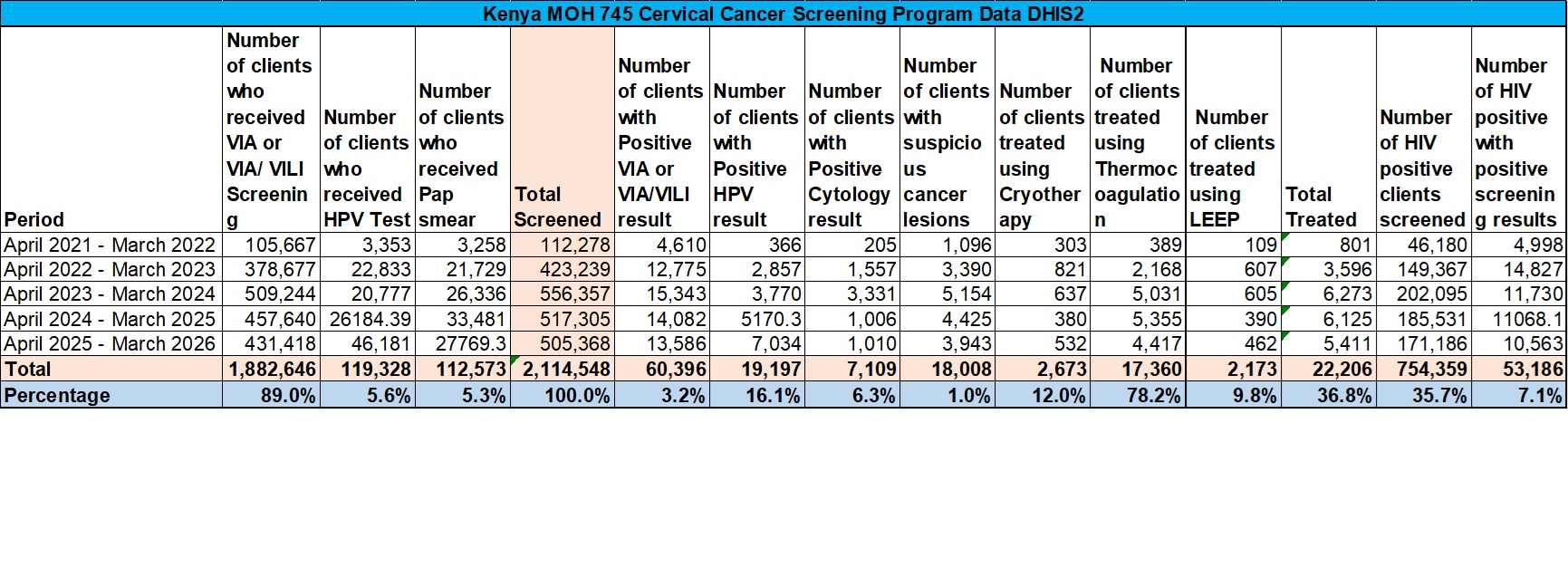
Conclusion: Kenya has demonstrated substantial gains in cervical cancer screening coverage, diagnostic capacity, and treatment of precancerous lesions over the past five years, with a notable pivot toward primary HPV testing and treatment with thermoablation. Reliance on VIA over HPV-based testing provides an important opportunity to strengthen molecular screening infrastructure. The elevated positivity among HIV-positive clients reinforces sustained integration of cervical cancer screening within HIV care services. Sustained investments are critical to achieving global targets.