Introduction:
Pregnancy provides a key opportunity to assess cervical screening history and offer screening, particularly for women with limited healthcare contact. We aimed to understand the number of under- or never-screened women in NSW that could be reached through antenatal and postpartum care, the extent to which this was already occurring, and factors associated with screening participation during pregnancy and post-partum.
Methods:
Using a population-based linked dataset of the NSW Perinatal Data Collection and Pap Test Register, we identified women who gave birth in NSW during 2007-2015 and aged 25-49 years at estimated last menstrual period (LMP) (baby’s date of birth minus gestational age in weeks) used as a proxy for start of pregnancy). We estimated the proportion overdue for cervical screening (no cytology test in previous three-years) at LMP; among these, the proportion screened by one-year-postpartum, overall and by maternal and health service characteristics; and examined factors associated with screening during the antenatal period and up to-one-year-postpartum.
Results:
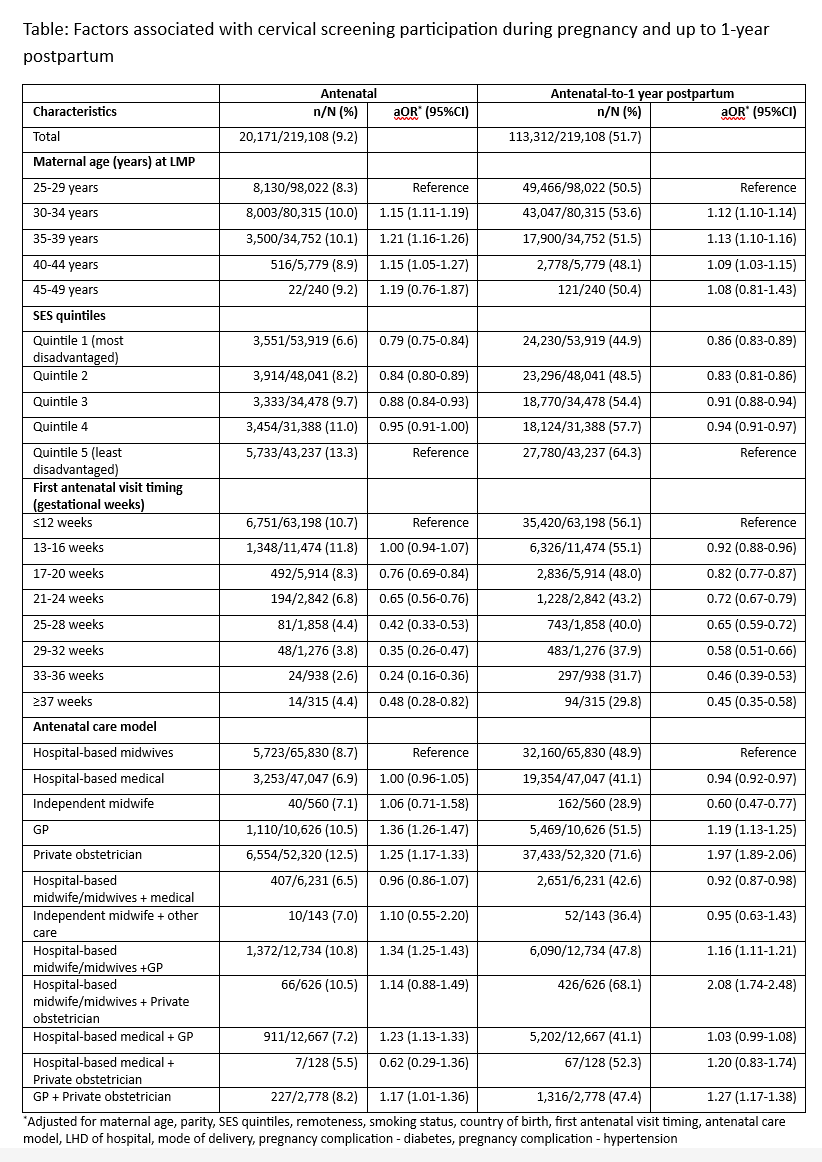
Of 685,120 pregnant women, 219,108 (32.0%) were overdue at LMP. Of these, 9.2% (n=20,171) were screened during the antenatal period, and 42.5% (n=93,141) during the first-year postpartum (51.7% screened overall). Women were less likely to be screened during the antenatal-to-one-year-postpartum period if they lived in the most (vs least) disadvantaged quintile (adjusted odds ratio (aOR):0.86;95%CI:0.83-0.89) and with later gestational age at first antenatal visit (vs ≤12 weeks), from 17-20 weeks (aOR:0.82;95%CI:0.77-0.87) to 21-24 weeks (aOR:0.72;95%CI:0.67-0.79). Mothers aged 30-44-years (vs 25-29-years) were more likely to be screened (aOR ranging from:1.09 to 1.13) as were those receiving antenatal care from GPs (aOR:1.19;95%CI:1.13-1.25) and private obstetricians (aOR:1.97;95%CI:1.89-2.06) (vs hospital-based midwives) (Table).
Conclusions:
There is a substantial missed opportunity for catch-up screening in antenatal and post-partum care. Although these data relate to Pap tests, failure to catch-up screening during the extended post-partum period remains relevant to HPV-based screening, suggesting that strategies to systematicallyoffer screening during antenatal care, now further enabled by self-collection, are needed.