
Introduction:
Excisional cervical precancer treatment is associated with increased risk of subsequent preterm birth (PTB). Human papillomavirus (HPV) vaccination has been shown to reduce cervical precancer and is thus predicted to reduce excisional cervical treatments and hence reduce PTB rates. We assessed the impact of HPV vaccination and vaccination age on excisional cervical treatment and future PTB rates.
Methods:
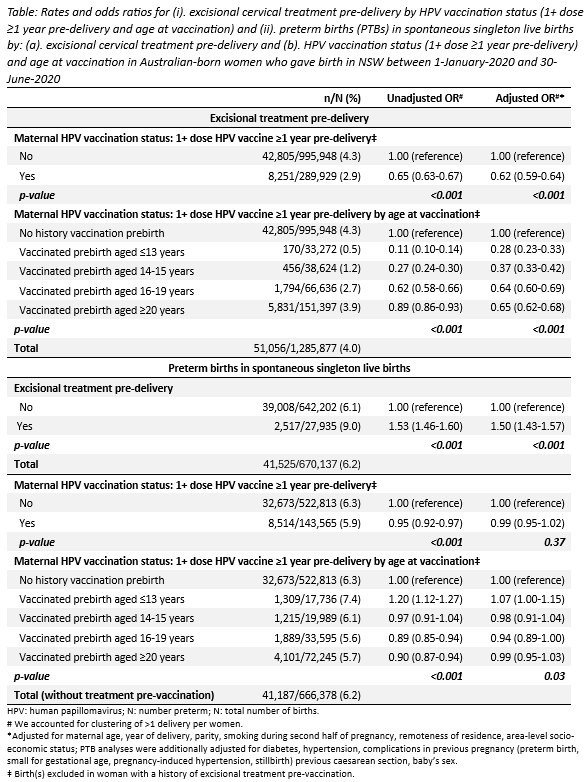
Using individually-linked data for Australian-born women who gave birth in NSW (1-January-2000 to 30-June-2020), we estimated rates and odds ratios (ORs) for (i) excisional treatment by 1+dose-HPV vaccination status and vaccination age; (ii) PTBs in women with spontaneous singleton liveborn deliveries by (a) previous excisional precancer treatment and (b) HPV vaccination status (1+ dose-HPV vaccine ≥1 year pre-delivery) and vaccination age. We adjusted for maternal age, delivery year, parity, smoking, socio-economic status and remoteness of residence, plus PTB risk factors (excluding excisional treatment) in PTB analyses (Table). We restricted the analysis to Australian-born women to reduce misclassification (overseas-born women may have been vaccinated/treated overseas).
Results:
Among 1,285,877 births, compared to unvaccinated women, previously vaccinated women had lower pre-delivery treatment odds (adjusted OR [aOR]:0.62,95%CI:0.59-0.64) (Table).
Among 670,137 spontaneous live singleton births, 6.2% were preterm. Mothers treated pre-delivery had increased PTB odds (aOR:1.50,95%CI:1.43-1.57). After adjustment, no significant difference in PTBs was found in vaccinated compared to unvaccinated mothers (aOR:0.99,95%CI:0.95-1.02). Vaccination age had an overall effect on PTBs (p=0.03), with a slight decrease in those vaccinated aged 16-19 years compared to unvaccinated mothers (p=0.04) (both adjusted).
Conclusion:
We confirmed an increased PTB risk in previously treated women and found HPV vaccination reduced excisional treatment risk. While we found no difference in PTBs in vaccinated compared to unvaccinated mothers, we identified a protective effect in those vaccinated aged 16-19. As many factors contribute to PTB, pooling international data may be needed to detect an impact of HPV vaccination.