Introduction: Since 1998, Swedish and Norwegian patients are transplanted in Gothenburg, Sweden. Initially, our institution managed the organ allocation of intestinal grafts for all patients. From 2010, due to a high mortality on the pediatric waiting list (WL) (70%), candidates were listed separately to increase awareness. From 2013 onwards, a joint Nordic shared waiting list (WL) was implemented for children listed for a liver transplantation and both pediatric and adult patients in need of an ITx; Herein, we describe and assess whether the change in WL algorithm implemented in 2010 has had an impact on WL dynamics for Swedish and Norwegian patients.
Matreials and methods: Retrospective review of the Nordic Liver Transplant Registry.
Variables studied: Comparison between (ERA 1: 1998-2010) and (ERA 2: 2011-2018). WL dynamics, organ donor characteristics, donor to recipient body weight ratio, cold ischemia time, mortality on the WL, proportion of grafts being shared between Swedish and Norwegian patients as well as the number of grafts imported from other Nordic and European countries.
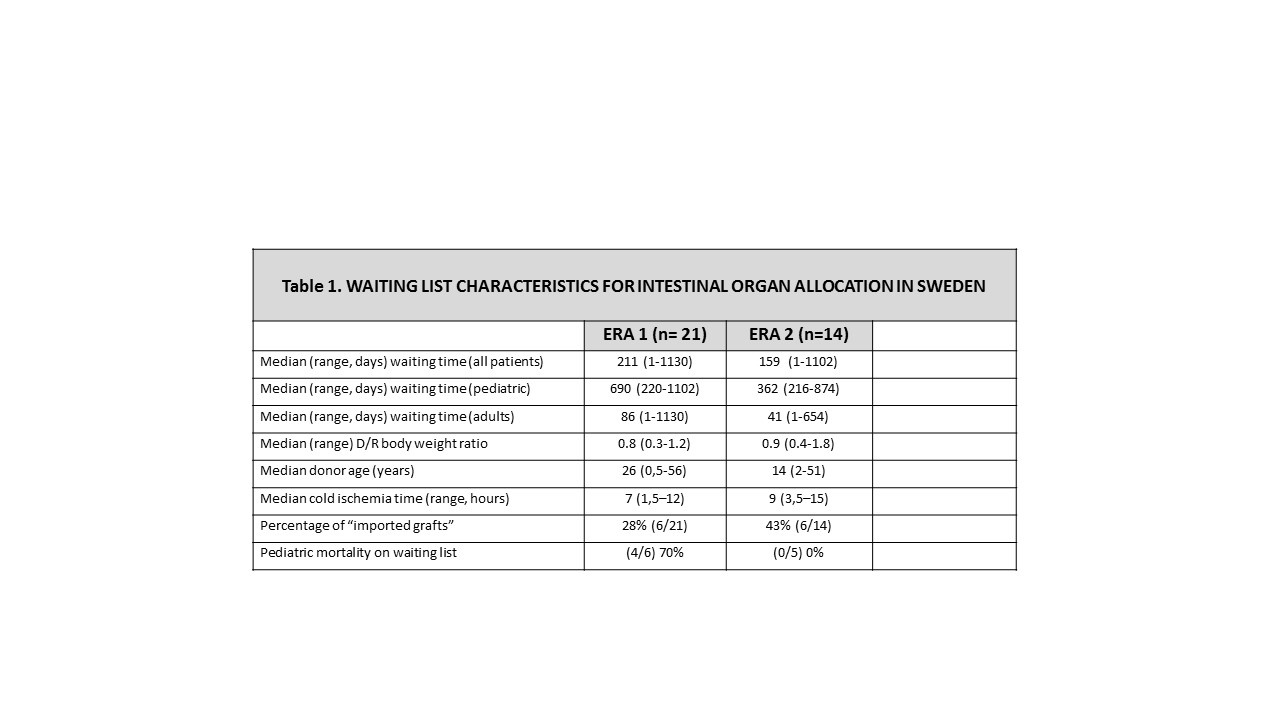
Results: 35 ITx have been performed in 34 patients; pediatric (9), adults (25). Isolated ITx (6) and MV grafts (29). Median time on the WL decreased when comparing ERA 1 and 2 but was not statistically significant (Table 1). Median waiting time for the pediatric recipients was longer than for the adults during both Eras. There were no mortalities on the WL after 2010. The proportion of grafts imported from other countries increased from 28% to 43% and the number of Swedish patients receiving grafts from other countries increased from 15% (n=3) to 33% (n=5). Eight Norwegian patients received 4 Swedish grafts and 4 Norwegian grafts. One isolated intestinal graft was harvested outside the Scandiatransplant procurement area (Switzerland).
Conclusions:
Changes in our Nordic waiting list policy appears to have shortened the waiting times, most notably for pediatric ITx candidates. No further mortalities on the WL occurred, but this may be attributed to other factors such as earlier referral for transplantation rather than changes in the shared waiting list. These data suggest an optimized utilization of the donor pool. Broadening the geographic procurement area may explain the longer cold ischemia times. Although many of the studied variables showed clear tendencies as mentioned above, they were not statistically significant. This may be due to the low number of observations.
.jpg )