Submission 53
Interdisciplinary Collaboration: Visualize AI'S Leapfrog in Post-Socialist China
SP03-03
Presented by: Ye ZHAO
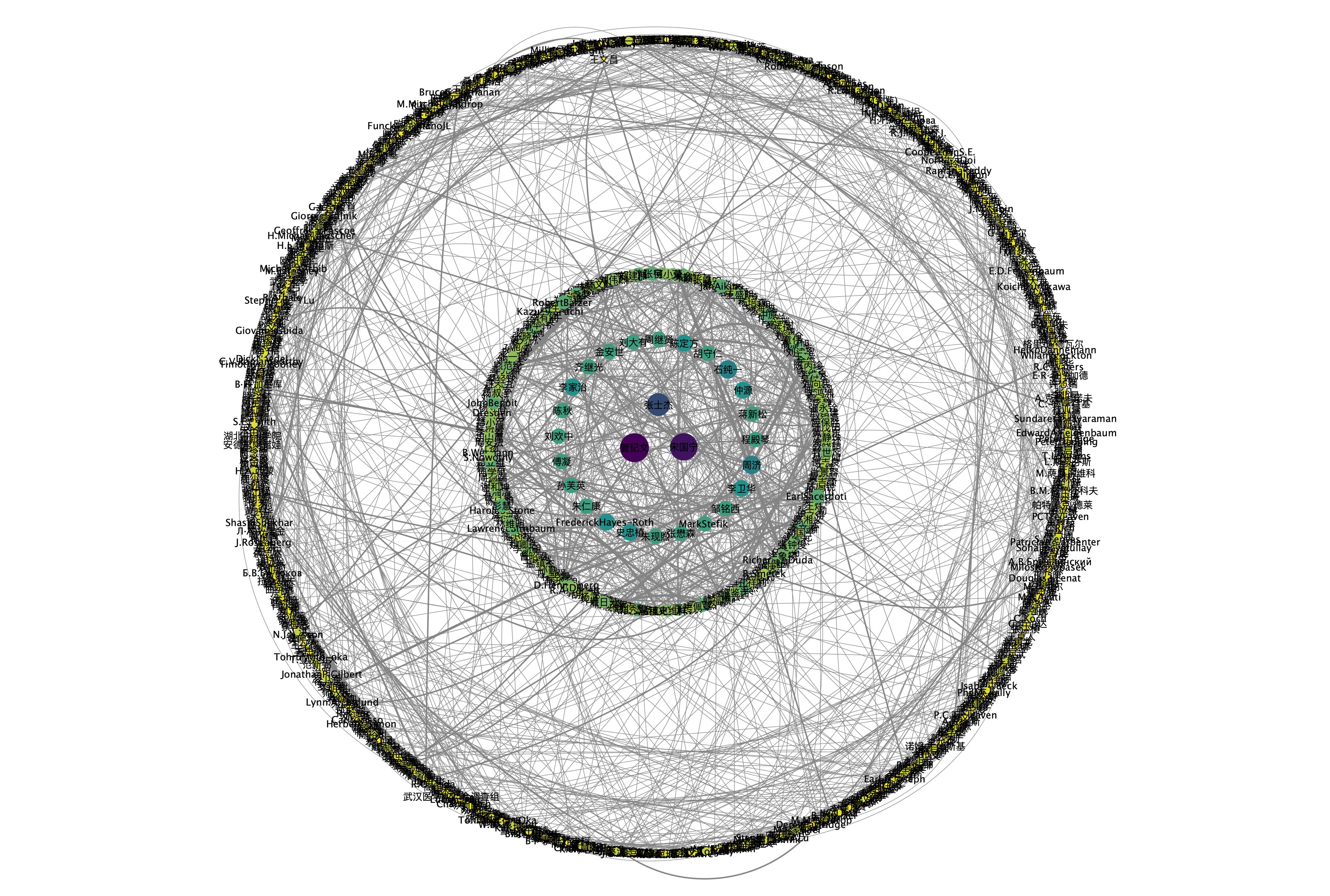
The project is empirically based on the study Machines, Cybernetics, and Computers: Sketchy Prehistories of AI in China. After building up a dataset of 265,593 articles from 1949 to 1990 downloaded from China National Knowledge Infrastructure (CNKI), one of the most influential digital databases in China, the project firstly yields and analyzes myriad bibliometric data through web scraping. The project selected 7 keywords in all, ren gong zhi neng [artificial intelligence], along with kong zhi lun [cybernetics], xin xi [information], qing bao [information refers to cryptology], dian zi ji suan ji [electronic computer], ji qi [machine], and zi dong hua [automation]. Leveraging Cytoscape, a visualization tool for social network analysis (SNA), the project has then constructed massive master networks of collaboration among the mid-level researchers, hosting 54,472 nodes and 63,735 edges in all. Beyond that, 56 sub-networks are closely identified and analyzed through bibliometric study. By interpreting the attributes of these sub-networks, the project also illuminates the trajectories of interdisciplinary cooperation in the fields of AI, machines, computers, and information from the early 1950s to the late 1990s.
Stemming from the contributions in the project Machines, Cybernetics, and Computers: Sketchy Prehistories of AI in China, this study narrates the digital prehistories in a manner of distant reading. The results of social network analysis showcase that the collaboration in the field of artificial intelligence began in the year 1979, with a total of 1671 cooperative researchers and 1780 cooperative relationships. Collaboration at the category and topic level elucidates the interdisciplinary traits of AI research, covering a wide spectrum like electronic technology and information science, automation technology, agricultural technology, scientific research management, mathematics, biology, psychology, publishing, geology, Chinese language and characters, clinical medicine, etc. Collaboration at the affiliation and institution level signifies the regional disparities, mainly concentrating in Northern China. The collaboration in the other 6 fields launched in the 1950s, while simultaneously leapfrogging in the year 1979 as well, with a deluge of scientific publications onward this decade. However, in the field of cybernetics, a 3-year persistent zero collaboration from 1979 to 1981 is also evidently witnessed. The advancement of collaboration within a variety of disciplines is fundamentally aligned with the increasing trends of journal publications after the end of the Cultural Revolution. By social network analysis and distant reading, the project fossilizes the endeavours of mid-level researchers made, contouring their contributions to seeding the knowledge of AI in the Post-Mao era.
The findings of this project fill the gap of narrating the prehistories of AI in China after the 1970s from the stance of empirical study. To my knowledge, this is the first study leveraging tremendous digital evidence to engage with the history of post-socialist China. The project sheds imperative light on the rethinking of the lesser elites—scientists and researchers working in various institutions—for developing holistic and plural histories of Chinese technology. The unveiling of historic plurality contributes to flourishing our perception on the ebbs and flows of the AI revolution in modern China, Asia, and even the world.